Last updated June 24, 2026
How to Hire a Garage Door Contractor in Santa Monica: A Step-by-Step Guide
One question exposes almost every low-quality garage door contractor in Santa Monica: “Who specifically will be doing the work?” If the person quoting the job can’t answer that with a name, you’re already being set up for a bait-and-switch. Most homeowners get burned not because they skipped getting quotes, but because they asked the wrong questions. This guide gives you the five questions that actually separate a qualified, accountable contractor from a commission-driven tech who vanishes after the invoice clears — plus everything else you need to hire confidently in the Santa Monica market.
Quick Answer
To hire a garage door contractor in Santa Monica, verify their California contractor’s license (Class C-61/D-28 or B), confirm who will physically do the work, check that they carry liability insurance, and read verified reviews for patterns — not just the star average. Getting multiple quotes is useful, but knowing which questions to ask matters far more than collecting the lowest number.
Table of Contents
- The Five Questions Every Santa Monica Homeowner Should Ask Before Booking
- How to Verify a California Contractor’s License in Under Two Minutes
- Why the Lowest Quote in Santa Monica Is Almost Never the Best Value
- What a Legitimate Warranty Looks Like — and What to Watch Out For
- How to Read Online Reviews Critically: What Verified Patterns Reveal
- Santa Monica-Specific Factors That Affect Your Garage Door Service
- Common Mistakes to Avoid
- When to Call a Professional
- Frequently Asked Questions
- The Bottom Line
The Five Questions Every Santa Monica Homeowner Should Ask Before Booking
Most hiring guides tell you to collect three quotes and pick the middle one. That’s not bad advice, but it misses the real filter: the answers to five specific questions will tell you more about a contractor’s character and competence than any price point ever will.
1. “Who specifically will be doing the work — and will that same person be there start to finish?”
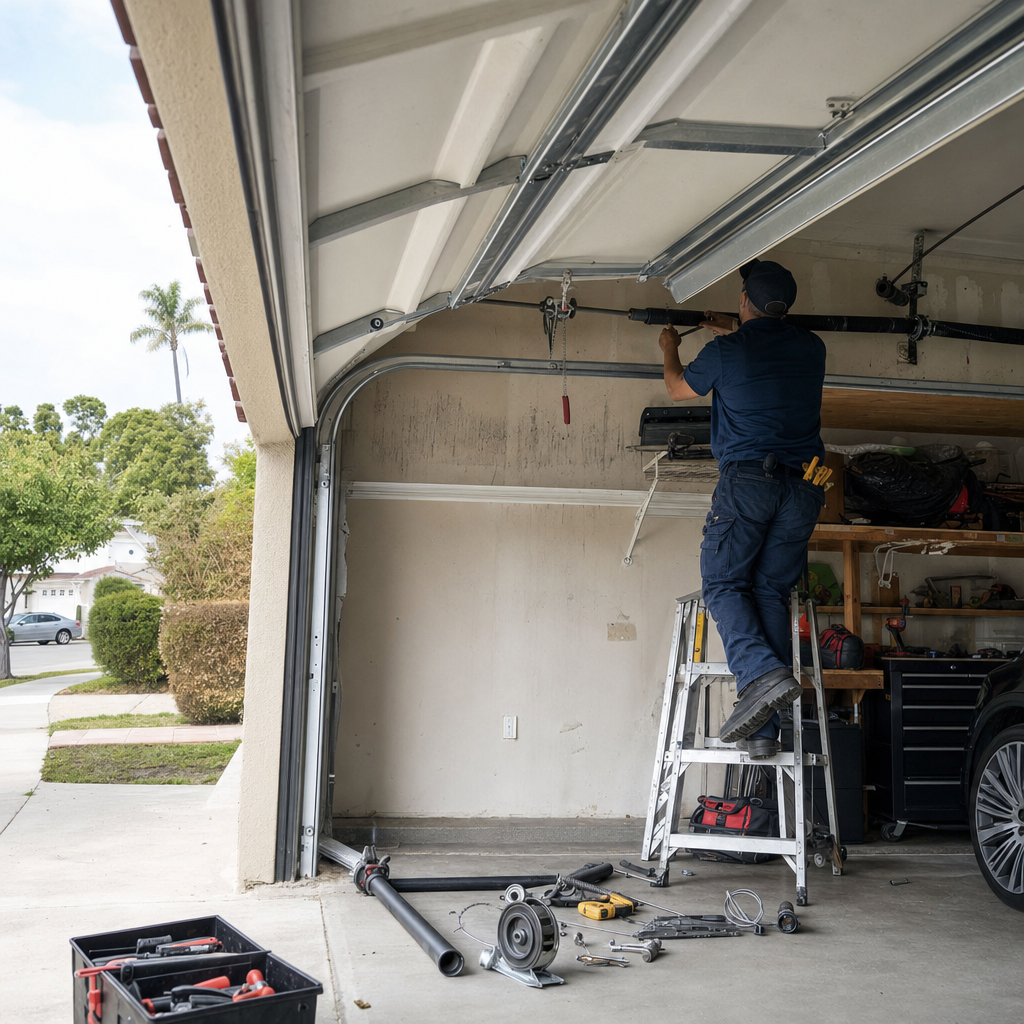
This is the single most revealing question you can ask. A franchise or large dispatch operation will often send a different technician than the one who gave the quote — or rotate subs depending on who’s available that day. The answer you want: a name, and a direct confirmation that the same person handles assessment and installation. When Matthew Anderson at Priority Garage Door Solutions arrives on a job, he’s the one who diagnosed it and the one completing it. That’s not the norm in this market — it’s the exception, and it’s worth specifically asking for.
2. “What California contractor’s license do you hold, and can I have the number?”
Any hesitation here is a red flag. A legitimate contractor can give you this number in seconds. We’ll cover exactly how to verify it in the next section, but the willingness to provide it immediately is itself a trust signal.
3. “Do you carry general liability and workers’ compensation insurance?”
In Santa Monica, where property values run high and homeowner liability exposure is real, an uninsured contractor working on your garage creates direct risk for you. If a sub-contractor is injured on your property and the company has no workers’ comp, that liability can land on your homeowner’s policy. Ask for a certificate of insurance — not a verbal confirmation.
4. “What brands are you trained and experienced on?”
This matters more than it sounds. A technician who primarily works on LiftMaster openers and Clopay doors may not have hands-on familiarity with a Wayne Dalton torque master system or a Raynor door with a proprietary track configuration. Brand-specific knowledge — earned over years, not read off a spec sheet — is what separates a clean repair from a misdiagnosis that costs you twice. Matthew has nearly two decades of daily field experience across LiftMaster, Chamberlain, Genie, Clopay, Amarr, Wayne Dalton, Craftsman, and Raynor. That breadth means whatever’s in your garage, the diagnosis starts from actual experience.
5. “What does your warranty cover, and who do I call if something fails?”
Pay attention to whether they describe the warranty terms clearly or hand you a pamphlet and move on. Also note: who specifically backs the warranty — the manufacturer, the company, or the technician? We’ll break down what legitimate warranty language looks like in a later section.
How to Verify a California Contractor’s License in Under Two Minutes
California requires contractors to hold a valid license issued by the Contractors State License Board (CSLB). For garage door work specifically, the relevant license classifications are:
- C-61/D-28 (Doors, Gates, and Activated Devices): This is the specialty license that directly covers garage door installation, repair, and opener work. It’s the one to look for first.
- Class B (General Building Contractor): A General B license covers work that involves two or more unrelated trades — holders can legally perform garage door work as part of a broader scope, but it’s not a specialty credential.
- Class A (General Engineering): Not relevant for residential garage door work.
To verify in under two minutes:
- Go to cslb.ca.gov and click “Check a License.”
- Enter the contractor’s license number or business name.
- Confirm the license is Active — not expired, suspended, or revoked.
- Check that the classification covers garage door work (D-28 or B).
- Verify the bond is current — this protects you if the contractor causes damage and won’t pay.
In our experience serving Santa Monica homeowners for over 18 years, the contractors who balk at providing a license number are almost always operating without one, or on a lapsed credential. It takes 90 seconds to check. Do it every time.
Why the Lowest Quote in Santa Monica Is Almost Never the Best Value
Santa Monica’s real estate market means the average garage door isn’t just a convenience — it’s a security and curb-appeal feature on a property worth well over a million dollars. A $75 repair that fails in three months costs more than a $250 repair done correctly the first time, and that math gets worse when you’re talking about a full door installation on a 1920s craftsman in Ocean Park or a modern two-car setup in Mid-City.
Here’s how low-quote contractors typically make up the margin:
- Aftermarket parts sold as OEM: Generic springs, cables, and rollers are quoted cheap and fail faster. You won’t know the difference until you’re calling for the same repair six months later.
- Incomplete diagnosis: Quoting to fix only the symptom you described, not the underlying cause — which means the technician is back (and billing again) when the root issue surfaces.
- Bait pricing with upsell pressure: A low “trip fee” or “assessment fee” gets the tech in your door, then the quote escalates once they’re on site and you’re already committed to the appointment.
- Uninsured labor: Cheaper because they’re cutting the cost of carrying insurance — and transferring that risk to you.
Fair pricing in the Santa Monica market for common services: spring replacement typically runs $150–$350 depending on spring type and door weight; a single-car opener installation ranges from $300–$550 installed with a quality unit like a LiftMaster or Chamberlain; cable replacement generally falls between $100–$200. If a quote comes in dramatically below these ranges, ask specifically what parts brand is being used and whether labor and parts are both covered under warranty.
What a Legitimate Warranty Looks Like — and What to Watch Out For
Warranties are where a lot of homeowners get burned without realizing it until it’s too late. Here’s how to read them critically.
What a real warranty covers:
- Parts and labor separately stated: A legitimate warranty specifies both — not just “parts” (which leaves you paying labor for the callback) or just “our workmanship” (which doesn’t cover part failure).
- A specific timeframe: “Lifetime warranty” on a spring is a red flag — springs have a cycle life, not a calendar life. A credible warranty states the coverage period clearly: 90 days, one year, five years — and what it covers within that window.
- A named contact for warranty claims: Who do you call? What’s the number? What’s the response window? If the answer is vague, the warranty is effectively unenforceable.
What to watch out for:
- Warranties voided by “improper use” — defined so broadly that any failure can be blamed on you.
- Manufacturer-only warranties on parts installed by a company that won’t stand behind the labor.
- No written warranty at all — a verbal promise that evaporates with a disconnected phone number six months later.
When evaluating Garage Door Repair in Santa Monica, ask directly: “If this part fails in 90 days, what is the process and what will it cost me?” The answer tells you more than the warranty document itself.
How to Read Online Reviews Critically: What Verified Patterns Reveal
Star ratings are a starting point, not a verdict. Here’s what to look for beyond the average score:
Volume consistency over time:
A company with 1,100+ reviews accumulated over years tells a different story than a company with 50 reviews posted in a three-month burst. Priority Garage Door Solutions has earned 1,118 verified reviews at a 4.9-star average — that kind of consistency across years reflects a real pattern of repeated trust from Santa Monica homeowners, not a one-time ratings campaign.
How the business responds to negative reviews:
Every company eventually gets a negative review. What matters is whether the owner responds specifically and professionally, or with a generic deflection. An owner-operator who responds by name — and offers a direct path to resolution — is showing you exactly how they’ll handle problems on your job.
What reviewers describe specifically:
- Do they name the technician? (A positive sign of personal accountability)
- Do multiple reviewers mention the same issue — whether positive or negative? (Pattern recognition beats individual data points)
- Do reviews mention repeat business or referrals? (The highest form of customer satisfaction signal)
Red flags in review profiles:
- Reviews that all use similar phrasing or sentence structure — a sign of bulk generation.
- A high volume of one-star reviews mentioning the same contractor behavior (upselling, no-shows, wrong parts).
- No reviews older than 18 months on a company claiming years of experience.
Santa Monica-Specific Factors That Affect Your Garage Door Service
Hiring a garage door contractor in Santa Monica isn’t the same as hiring one in the Inland Empire or the San Fernando Valley — the local environment creates conditions that an inexperienced or out-of-area contractor may not anticipate.
Salt air and coastal corrosion:
Properties within a mile of the Pacific — from the Palisades corridor down through the beachside areas near Montana Avenue and Ocean Park — experience accelerated metal corrosion from marine-layer humidity and salt air. Springs, cables, and tracks on doors in these zones degrade measurably faster than doors five miles inland. A contractor who doesn’t account for this when recommending parts — or who installs standard galvanized hardware where stainless or coated components belong — is setting you up for a repeat service call within 18 months. We see this regularly on first-visit diagnoses after another company’s work.
Older housing stock and non-standard openings:
Santa Monica has a significant inventory of pre-1960 homes, particularly in the north of Wilshire and Sunset Park neighborhoods. These properties often have non-standard garage openings — low headroom clearances, irregular width, or original wood frames that require custom track configurations. Not every contractor is equipped to handle these, and a standard installation quote may not apply.
HOA and local permit requirements:
If your property is in an HOA — common in newer mid-city and mixed-use developments — garage door replacement may require HOA approval before work begins, in addition to a City of Santa Monica building permit for full installation. Confirm with your contractor that they pull permits when required; unpermitted work can create title issues when you sell.
For a Garage Door Installation in Santa Monica, working with a contractor who knows local conditions isn’t a preference — it’s a practical requirement.
Common Mistakes to Avoid
- Booking the first contractor who answers the phone without asking qualifying questions. Urgency — especially after a spring break or a door stuck in the down position — is exactly when commission-driven contractors count on you to skip the vetting process. Take five minutes to ask the five questions above, even in an emergency.
- Assuming all openers are the same. A technician unfamiliar with your specific brand — whether it’s a Genie screw-drive, a Chamberlain belt-drive, or an older Craftsman chain system — will take longer, charge more, and may misdiagnose the problem. Brand-specific experience isn’t a bonus, it’s a prerequisite. When considering Garage Door Opener in Santa Monica, ask about your exact model.
- Skipping the license verification step because the contractor seemed professional. Presentation has nothing to do with licensure. A CSLB check takes 90 seconds and is the only objective confirmation that a contractor is legally permitted to do the work.
- Accepting a verbal warranty instead of a written one. In our 18 years serving Santa Monica, some of the most frustrating customer situations we’ve encountered are homeowners who paid another company, were given a verbal “we’ll stand behind our work” guarantee, and then couldn’t reach anyone when something failed. Get it in writing, with specifics.
- Choosing a contractor based on proximity ads alone. Several services advertise as local Santa Monica businesses but actually dispatch from centralized hubs in Van Nuys or Torrance — meaning the “local” tech on your job has no particular familiarity with coastal conditions or older housing stock specific to this city.
- Ignoring the hardware during a spring or cable repair. When one spring fails on a two-spring system, both springs are near the end of their service life. A contractor who only replaces the broken one — without disclosing that the second is likely to fail within weeks — is technically completing the job while leaving you with a return call baked in.
- Not asking about parts sourcing before work begins. The difference between a name-brand Clopay section or an Amarr panel and a generic aftermarket equivalent can be significant in terms of finish match, durability, and warranty eligibility. Know what you’re getting before the technician starts.
When to Call a Professional
Some garage door issues are genuinely DIY-appropriate — lubricating hinges, adjusting the open-limit settings on an opener, or replacing a remote battery. But these situations call for a professional, and attempting them without training can cause injury or further damage:
- Broken torsion or extension springs — these are under extreme tension and can cause serious injury if mishandled.
- Cables off the drum or visibly frayed.
- A door that has come off its tracks — especially partially, where the panel is bowed or binding.
- Any electrical issue with the opener motor unit or wiring.
- A door that won’t close fully — which is a security and safety issue that shouldn’t wait.
- After any vehicle impact or structural event, even if the door appears to open and close normally.
Priority Garage Door Solutions Santa Monica offers free estimates in Santa Monica for non-emergency situations, and we’re available for urgent calls when the problem can’t wait. Reach us at (844) 460-7214 — Matthew handles it personally.
Frequently Asked Questions
How much does it cost to hire a garage door contractor in Santa Monica?
Costs in Santa Monica typically range from $100–$250 for minor repairs like cable or roller replacement, $150–$350 for spring replacement, and $300–$550 installed for a new opener from a major brand like LiftMaster or Chamberlain. Full door installations vary widely based on material, size, and whether the opening is standard — expect $800–$2,500+ for a complete single-car installation with hardware. These ranges reflect fair-market pricing for licensed, insured work with quality parts; quotes significantly below these figures usually indicate shortcuts somewhere in the job.
Does a garage door contractor in California need a license?
Yes — in California, any garage door contractor performing work valued at $500 or more in labor and materials is legally required to hold a valid CSLB license. The relevant classification for garage door specialists is C-61/D-28 (Doors, Gates, and Activated Devices). You can verify any contractor’s license status in about 90 seconds at cslb.ca.gov. Working with an unlicensed contractor voids most homeowner’s insurance protections for that work and leaves you with no recourse through CSLB if something goes wrong.
How do I know if a Santa Monica garage door contractor is actually local?
Ask directly where they’re dispatched from, and check whether their verified reviews mention Santa Monica neighborhoods specifically — Ocean Park, Sunset Park, Mid-City, Pico, north of Montana. A contractor genuinely serving this area will have service history in these neighborhoods and familiarity with local factors like coastal corrosion, older housing stock, and city permit requirements. Some companies advertise Santa Monica service but dispatch from hubs in the Valley or South Bay — response times and local knowledge both suffer as a result.
What’s the difference between a garage door repair company and a general handyman for this work?
Garage door systems — particularly torsion springs, cable drums, and modern opener electronics — are specialized equipment. A general handyman may handle surface-level tasks but typically lacks brand-specific training on systems like Wayne Dalton torque masters or LiftMaster’s MyQ platform. More importantly, a handyman may not carry the C-61/D-28 classification required for licensed garage door work in California, which creates a liability gap for you as the homeowner. Stick to a dedicated garage door contractor for anything beyond cosmetic maintenance.
How important is it to match a new garage door to my existing opener?
Compatibility matters, but it’s not always a barrier. Most modern openers from Chamberlain, Genie, Craftsman, and similar brands are compatible with standard door weights and configurations. Where it gets complicated is with heavier doors — solid wood, double-layer steel, or oversized panels — that may require a higher-horsepower motor than your current opener provides. A qualified contractor will assess the existing opener as part of any installation consultation and flag compatibility issues before work begins, not after the new door is hung.
Should I get multiple quotes for garage door work in Santa Monica?
Getting two or three quotes for larger projects — new door installation, full opener replacement, or significant structural repairs — is a reasonable practice and gives you a market reference point. For smaller repairs, the more useful filter is asking the five qualifying questions in this guide rather than chasing the lowest number. A quote from an unverified, uninsured contractor who can’t name the technician doing the work isn’t a useful data point, regardless of the price.
The Bottom Line
Hiring a garage door contractor in Santa Monica comes down to five things: knowing who will actually do the work, verifying their California license, confirming they carry insurance, understanding what the warranty actually covers, and reading reviews for patterns instead of just the star average. Price matters — but the lowest quote in this market almost always carries a hidden cost. Nearly two decades of daily work across Santa Monica homes, 1,118 verified reviews at a 4.9-star average, and an owner who personally handles every job — that’s the standard worth holding any contractor to. When you’re ready to move forward, call Priority Garage Door Solutions at (844) 460-7214 for a free estimate. Matthew will answer, and Matthew will show up.
Written by the team at Priority Garage Door Solutions Santa Monica, serving Santa Monica since 2008.