Last updated June 11, 2026
Garage Door Permits, Codes & Inspections in CA: What You Need to Know
Every year, Santa Monica homeowners sit across from a buyer’s agent during escrow and hear the same uncomfortable sentence: “There’s an open permit issue on the garage door replacement.” A contractor told them it was a simple swap — no permit needed — and they believed it. Now they’re either pulling a retroactive permit under deadline pressure, renegotiating the sale price, or watching a buyer walk. California’s garage door permit rules aren’t complicated once you understand them, but the cost of misunderstanding them shows up years after the work is done. This guide covers every trigger, every exemption, and every local wrinkle that affects homeowners in California — with particular attention to what Santa Monica’s municipal code adds on top of the state baseline.
Quick Answer
In California, a like-for-like garage door replacement — same size, same opening, no structural changes — generally does not require a building permit. However, any project that modifies the structural header, creates a new opening, changes the door’s size, involves seismic bracing upgrades, or occurs within a designated historic district does require a permit. In Santa Monica specifically, ADU conversions involving garage spaces and work in historic overlay zones trigger additional municipal review requirements on top of the state minimum.
Table of Contents
- When a Permit Is Required in California
- The Like-for-Like Exemption: What It Covers and What It Doesn’t
- Santa Monica-Specific Code Requirements
- California’s Seismic Bracing Requirements for Garage Doors
- Insurance and Resale Consequences of Skipping a Permit
- How to Retroactively Permit Completed Garage Door Work
- What the Inspection Process Actually Looks Like
- Common Mistakes to Avoid
- When to Call a Professional
- Frequently Asked Questions
- The Bottom Line
When a Permit Is Required in California
California’s building permit requirement for garage doors flows from the California Residential Code (CRC), which is the state’s adoption of the International Residential Code with California-specific amendments. The guiding principle is straightforward: if the work affects the structure of the building, or if it changes the character of an existing opening, it requires a permit. Here’s where it gets specific.
Projects that definitively require a building permit in California:
- Structural header modifications: If a contractor needs to alter, sister, or replace the load-bearing header above the garage door opening — for example, widening a single-car opening to fit an SUV — a permit is required without exception. This is structural work that affects how your home handles vertical load.
- Creating a new garage door opening: Cutting a new opening in a garage wall that did not previously have one always requires a permit and engineering review.
- Changing the door’s rough opening size: Going from a 7-foot to an 8-foot tall door, or widening from 8 feet to 9 feet, triggers a permit because the framing must be modified.
- ADU conversions: Converting a garage space into an Accessory Dwelling Unit — extremely common in Santa Monica — requires a full set of permits that includes any garage door work, typically involving the removal of the door and sealing of the opening.
- Fire-rated assemblies: If the garage is attached to the living space, California requires the garage-to-home wall to meet specific fire-resistance ratings. Any door replacement adjacent to that assembly may require inspection to confirm fire-rating compliance is maintained.
- Commercial garage doors: This guide focuses on residential, but note that commercial work in California operates under a stricter permitting framework with no like-for-like exemption.
If you’re unsure which category your project falls into, the Santa Monica Building & Safety Division on Main Street is the authoritative source — not your contractor, and not a general internet answer.
The Like-for-Like Exemption: What It Covers and What It Doesn’t
The most misunderstood concept in residential garage door permitting is the like-for-like (or “in-kind”) replacement exemption. California generally allows homeowners to replace a garage door with a unit of the same size and type — using the existing rough opening, existing structural header, and existing track configuration — without pulling a building permit. This is the scenario that covers the majority of straightforward garage door replacements.
But the word “like-for-like” carries more weight than most homeowners realize. Here’s what it requires in practice:
- Same rough opening dimensions: The new door must fit the existing opening without modification to the framing.
- No header work: The existing structural header must remain untouched. If a contractor discovers the header is undersized or damaged and needs to be replaced, that work requires a permit — even if the door size isn’t changing.
- Same door type (sectional vs. one-piece): Switching from a one-piece tilt-up door to a sectional door may require different hardware configurations and track mounting, which some jurisdictions consider a change beyond in-kind replacement.
- No change to fire-rated assembly: If your door is part of a fire-rated separation between living space and garage, the replacement door must carry equivalent fire-rating documentation.
In our experience after nearly two decades working on doors across the Santa Monica area, contractors sometimes tell homeowners a project “doesn’t need a permit” because they’re simplifying — or because they don’t want the delay. That’s a gamble the homeowner pays for, not the contractor, when it surfaces during a home sale.
Santa Monica-Specific Code Requirements
Santa Monica operates under the California Building Code but enforces its own municipal amendments through the Santa Monica Municipal Code (SMMC). For garage doors, three local factors create requirements that go beyond what a general California guide will tell you.
Historic Preservation Overlay Zones
Santa Monica has several designated historic districts and individual landmarks — portions of North of Montana, areas near Sunset Park, and properties on the city’s historic register — where exterior modifications including garage door replacement require review by the Architectural Review Board or the Landmarks Commission, depending on the property’s designation status. This applies even to like-for-like replacements if the new door changes the visual character of the exterior. Replacing a wood carriage-style door on a 1930s Craftsman bungalow with a contemporary flush aluminum panel, for example, is not an administrative rubber stamp in these zones.
ADU Regulations
Santa Monica has been an active ADU market for years, and garage conversions are one of the most common paths. Under California’s ADU laws (AB 2221 and SB 897, as amended) and Santa Monica’s local implementation, a garage conversion that involves removal of a garage door and in-fill of the opening requires a building permit, an electrical permit (for the outlet circuit requirements in new habitable space), and may require mechanical and plumbing permits depending on the scope. The garage door is often the first item on the work list, but it cannot be addressed in isolation from the broader conversion permit set.
Coastal Zone Considerations
Properties within Santa Monica’s Coastal Zone may fall under California Coastal Commission jurisdiction for certain exterior modifications. While a standard door replacement on a typical residential lot generally doesn’t trigger Coastal Development Permit requirements, projects involving structural changes to garage openings on properties near the beach should verify their Coastal Zone status before beginning work.
California’s Seismic Bracing Requirements for Garage Doors
California is earthquake country, and garage doors sit at a particular vulnerability point in residential construction: a large, heavy panel spanning a wide opening, supported by a spring and track system that can fail dramatically under seismic stress. The California Building Code incorporates provisions from FEMA P-807 and related guidelines for cripple walls and garage door openings in high-seismic-risk zones, which covers virtually all of Southern California.
What the seismic requirements actually address:
- Cripple wall bracing: Many older Santa Monica homes built before the 1994 Northridge earthquake have unbraced or inadequately braced cripple walls (the short framed walls between the foundation and the first-floor framing). Garage door openings represent the longest unbraced span in these walls. During permitted work, an inspector may note cripple wall deficiencies that require correction.
- Door panel rigidity: Modern sectional garage doors built to California standards must meet minimum panel rigidity requirements so that a door panel doesn’t buckle under lateral seismic load and jam the door in a closed position — which would trap vehicles and block emergency egress.
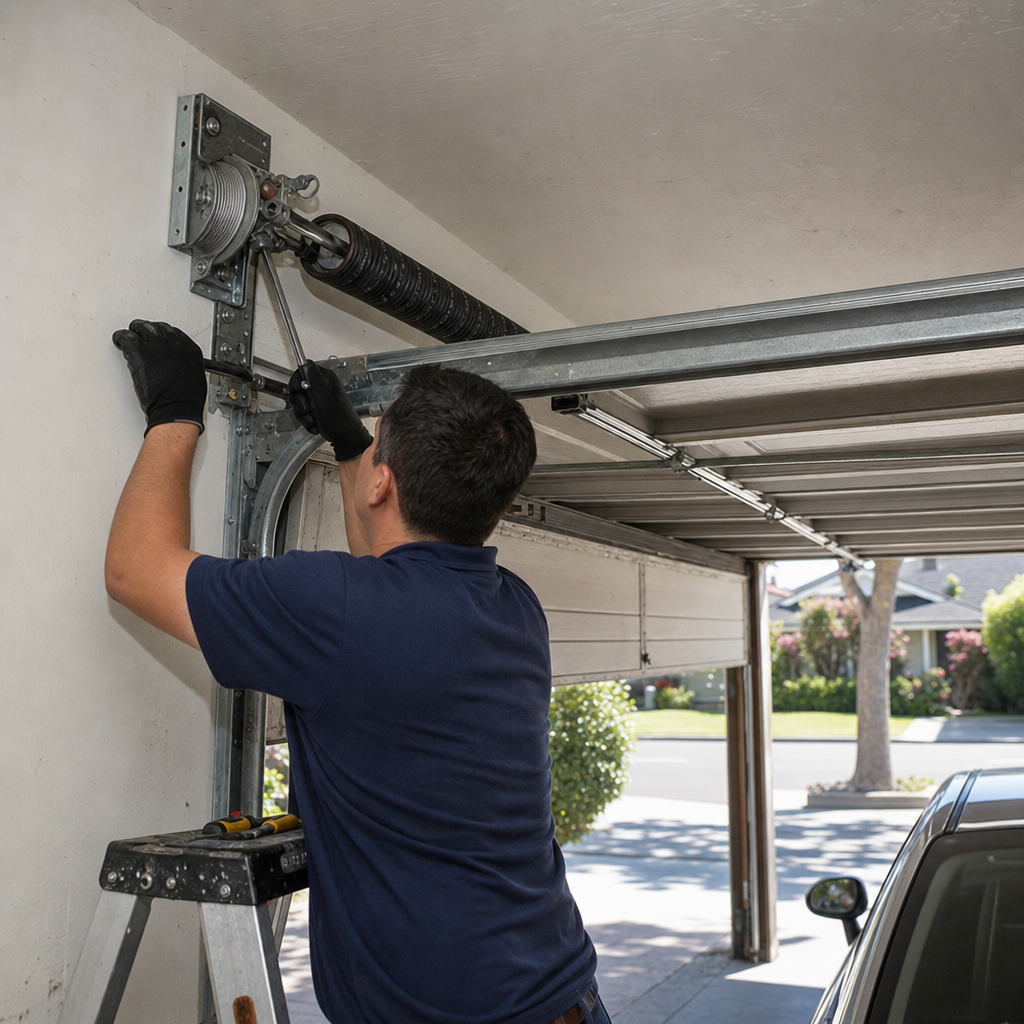
- Torsion spring systems: For doors over a certain weight threshold, California amendments favor torsion spring systems over extension springs in part because torsion springs contain their failure energy more effectively. A Clopay or Wayne Dalton heavy door installed on undersized extension springs may not pass inspection in a seismically active zone.
- Opener anchorage: LiftMaster and Chamberlain openers installed in California must be anchored to the framing in a way that meets seismic anchorage requirements — a detail that varies from installations in lower-risk states.
We’ve seen post-Northridge retrofits in Santa Monica where doors were replaced with seismically compliant hardware and properly anchored openers, and the difference in how the system performs under minor shaking is measurable. This isn’t bureaucratic paperwork — it’s engineering with a real reason behind it.
Insurance and Resale Consequences of Skipping a Permit
This is the section most guides don’t write directly enough, so we will. Skipping a required permit isn’t just a code violation — it creates two downstream liabilities that cost homeowners real money.
Homeowner’s Insurance
Most standard homeowner’s insurance policies in California contain language requiring that covered structures be built and modified in compliance with local building codes. If a garage fire originates in or spreads through a garage opening that was structurally modified without a permit, your insurer has grounds to dispute the claim. This isn’t a theoretical risk — California insurance carriers have become significantly more rigorous about unpermitted work since the state’s wildfire and disaster claims surge. An unpermitted structural modification to a garage door opening creates a gap in your coverage that you won’t know about until you need to file a claim.
Home Sale and Escrow
California requires sellers to disclose known unpermitted work. A title search or home inspection that surfaces an unpermitted structural modification to a garage opening — whether from a permit history check or visible framing evidence — will generate a notation in the escrow process. Buyers typically respond in one of three ways: they request a price reduction to cover the cost of retroactive permitting, they require the seller to pull the permit and complete inspection before closing, or they walk away entirely. In Santa Monica’s high-value real estate market, where homes routinely transact well above the state median, a $500 permit skipped can become a $5,000–$15,000 negotiating concession at the sale table.
How to Retroactively Permit Completed Garage Door Work
If work was already done without a required permit, the path forward is a retroactive (or “after-the-fact”) permit. It’s not a comfortable process, but it’s far better than leaving the issue unresolved — especially before a home sale.
Step-by-step process for retroactive permitting in Santa Monica:
- Assess the scope of work that was done. Before approaching the city, document exactly what was changed — header dimensions, rough opening size, structural framing, any hardware. Photos help significantly.
- Contact the Santa Monica Building & Safety Division. Schedule a pre-application meeting or call the counter to describe the work. Ask directly: does this scope require a retroactive permit? Get their answer in writing if possible.
- Prepare permit documents. For structural work, you’ll likely need a site plan and possibly a letter from a licensed structural engineer confirming the header size and framing meet current code. For simple like-for-like work that was incorrectly categorized as unpermitted, documentation is lighter.
- Submit the permit application. Santa Monica accepts permit applications through its online portal and in-person at the Building Counter. Expect to pay both the original permit fee and a penalty surcharge for work done without a permit — typically 50%–100% of the standard fee, depending on the scope.
- Schedule the inspection. An inspector will need to visually assess the completed work. In some cases, if work is enclosed behind drywall, the inspector may require a portion of the wall to be opened for access. Factor this into your planning — and your contractor’s schedule.
- Receive final sign-off. Once the inspector approves, you’ll receive a final permit card and the permit will be recorded in the city’s permit history. This is what clears the escrow issue.
Realistic timeline: 2–6 weeks in Santa Monica for straightforward cases. If engineering review is required, add 3–8 weeks depending on engineer availability. Realistic cost: permit fees of $150–$500 for basic residential work, plus engineer fees of $500–$1,500 if a structural letter is required, plus any correction work if the inspector finds the existing installation doesn’t meet code.
What the Inspection Process Actually Looks Like
Most homeowners have never watched a garage door inspection and imagine it as more intimidating than it is. Here’s what a Santa Monica building inspector is actually looking at when they sign off on permitted garage door work.
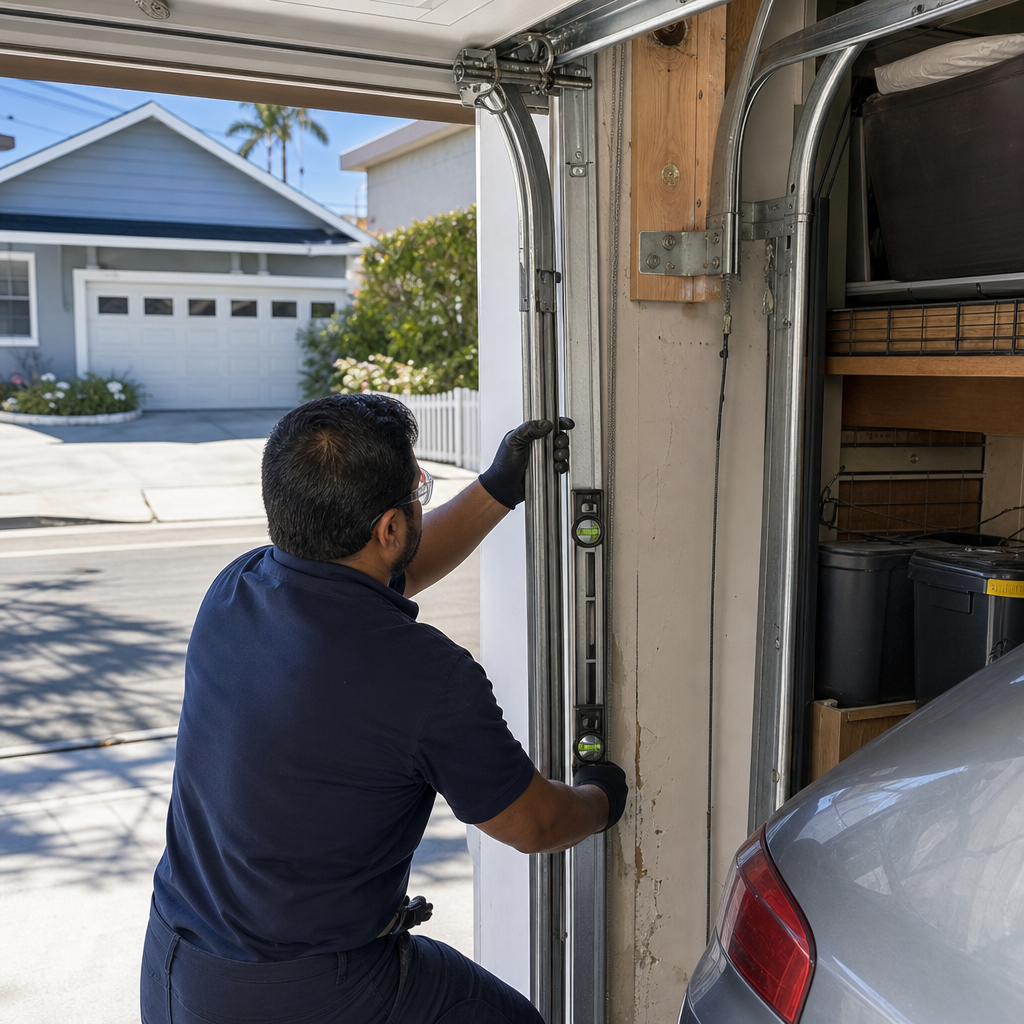
- Header size and condition: The inspector verifies that the structural header above the opening is sized appropriately for the span, per the California Residential Code span tables. For a typical 16-foot wide garage opening, a minimum double 2×12 or engineered lumber equivalent is standard in most California framing scenarios.
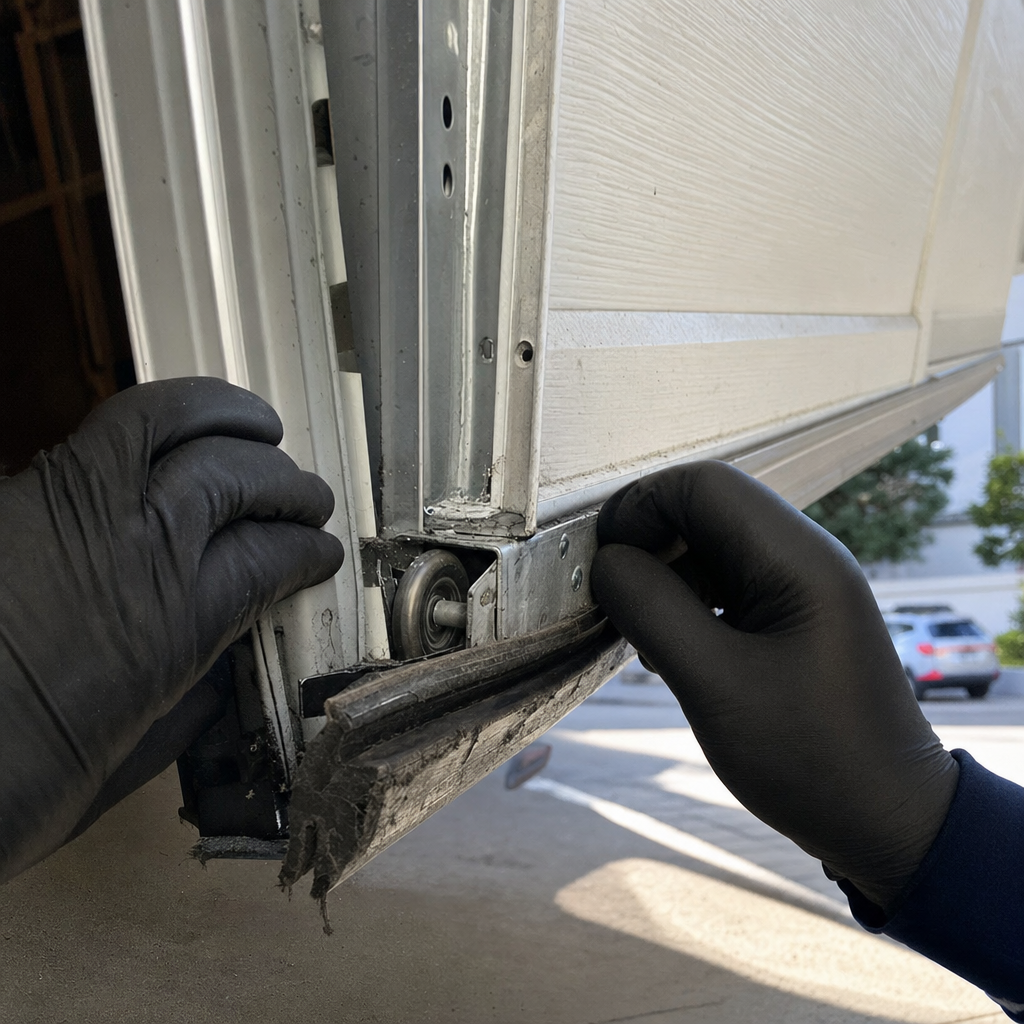
- Fastening and hardware: Track mounting bolts, torsion spring bar anchoring, and — if a new opener was installed — the opener rail mounting to the header bracket are all checked. A LiftMaster or Genie opener mounted with improper fasteners or into inadequate backing won’t pass.
- Safety reversal function: For any door with a powered opener, the auto-reverse obstruction sensor must be tested. This is a functional test, not just a visual check. Chamberlain and LiftMaster openers with Safety Sensors meet this without modification; older Craftsman units on the margin of their compliance lifespan sometimes don’t.
- Fire-rated door (if applicable): If the door separates a living space from the garage, the inspector will verify the door’s fire-rating label and confirm proper installation clearances.
- General weatherproofing: Not a code requirement per se, but inspectors frequently note visible gaps that affect energy compliance in California’s Title 24 framework.
A first-time inspection pass is the norm when the installation was done correctly. Re-inspections — when work doesn’t pass the first time — typically add one to two weeks and an additional re-inspection fee in Santa Monica.
Common Mistakes to Avoid
- Taking a contractor’s word that “it doesn’t need a permit” without verifying. The liability for unpermitted work stays with the property owner, not the contractor. A five-minute call to the Santa Monica Building Counter takes that risk off your plate entirely.
- Assuming like-for-like means no permit under any circumstances. If your existing header is damaged and needs to be replaced as part of the project, that portion of the work triggers a permit even if the door size isn’t changing. We’ve seen this scenario more than once in older Ocean Park and Wilshire Montana homes.
- Installing a wider door without verifying header capacity. Going from a 16-foot double to an 18-foot double opening to fit a larger vehicle requires a larger header span — which requires a permit, structural review, and possibly an upgrade to the foundation connection. Doing it without a permit is one of the more expensive surprises in residential construction.
- Not checking historic overlay status before replacing a garage door. Several Santa Monica neighborhoods have historic overlay zones where exterior changes require review beyond a standard building permit. Replacing a historically appropriate door style without ARB sign-off in these areas can result in mandatory restoration at the homeowner’s cost.
- Skipping the seismic anchor requirements on opener installations. A Raynor or Amarr door installed with a properly anchored opener in an older Santa Monica garage is meaningfully safer in a seismic event than the same door with generic mounting hardware. Inspectors know the difference.
- Assuming an ADU garage conversion only needs one permit. The garage door removal and in-fill is one piece of a multi-permit package for an ADU. Pulling only the mechanical or electrical permit without the building permit — or vice versa — creates a permit record that appears incomplete and will surface during a title search.
- Waiting until you’re in escrow to address a known permit issue. Retroactive permits pulled under the time pressure of a closing are expensive and stressful. Addressing unpermitted work proactively — on your timeline, not a buyer’s — almost always costs less and resolves more cleanly.
When to Call a Professional
If your garage door project falls outside a clean like-for-like replacement — any header work, size change, ADU involvement, or historic district location — working with an experienced professional isn’t optional, it’s practical protection. A contractor who knows Santa Monica’s permitting process, understands California’s seismic requirements, and can accurately assess whether your project triggers a permit saves you the retroactive permitting headache that catches so many homeowners off guard.
Matthew Anderson at Priority Garage Door Solutions Santa Monica home has been handling permitted and unpermitted-work assessments in Santa Monica for nearly two decades. Whether you’re installing a new Clopay or Amarr door, upgrading to a LiftMaster opener, or trying to figure out what a previous owner’s contractor actually did, Matthew handles it personally — you’ll speak with the same person who does the assessment and the work. Call (844) 460-7214 for a free estimate. Over 1,100 Santa Monica-area neighbors have trusted that call — and the 4.9-star average across 1,118 reviews reflects what happened after it.
Frequently Asked Questions
Do I need a permit to replace a garage door in California?
Generally no — a like-for-like replacement that uses the existing opening size, existing structural header, and existing framing does not require a building permit in California. A permit is required when the project involves structural changes, size modifications, header replacement, or work in jurisdictions like Santa Monica with additional local requirements such as historic district review or ADU conversion permits.
Does Santa Monica have any special garage door requirements beyond state code?
Yes. Santa Monica enforces its municipal code on top of the California Building Code, with additional requirements for properties in historic preservation overlay zones, properties within the Coastal Zone boundary, and any garage space being converted to an ADU. The Santa Monica Building & Safety Division is the definitive source for your specific property’s requirements.
What happens if I replace my garage door without a required permit?
Skipping a required permit creates three potential consequences: a code violation notice (and associated fine) if discovered during a neighboring permit inspection or complaint, grounds for an insurance claim dispute if a loss occurs in the unpermitted space, and a negotiating issue during home sale when a buyer’s inspector or title search surfaces the unpermitted work. In Santa Monica’s competitive real estate market, this typically surfaces as a price reduction request or a pre-closing permit correction requirement.
What are California’s seismic requirements for garage doors?
California’s seismic provisions require that garage door installations in high-risk seismic zones — which includes all of Los Angeles County — address cripple wall bracing at the garage opening, panel rigidity minimums, torsion spring systems for heavy doors, and proper seismic anchorage for motorized openers. These requirements are enforced at the inspection stage for permitted work; unpermitted replacements in older Santa Monica homes frequently have non-compliant spring configurations that wouldn’t pass a current inspection.
How long does a retroactive garage door permit take in Santa Monica?
A retroactive permit for straightforward residential garage door work typically takes 2–6 weeks in Santa Monica from application to final inspection. If the scope of the original work requires a structural engineer’s letter — for example, to certify a modified or replaced header — add 3–8 weeks for engineering review. Plan for total costs of $650–$2,000 including permit fees, penalty surcharges, and engineering fees where required.
Is a permit required when adding a new garage door opener in California?
Adding or replacing a garage door opener on an existing door, using the existing rail and header bracket locations, typically does not require a building permit in California. However, if the opener installation involves new structural blocking, new electrical circuit work, or is part of a larger permitted project, those components may require permit coverage. A new 240V circuit for a commercial-duty opener would require an electrical permit separately from any building permit consideration.
The Bottom Line
California’s garage door permit rules are actually reasonable once you understand them: straightforward like-for-like replacements are exempt, structural and size-changing work is not. The complication comes from the local layer — Santa Monica adds requirements around historic zones, ADU conversions, and Coastal Zone properties that a general California guide won’t capture. Skipping a permit when one was legally required isn’t a minor administrative shortcut; it’s a liability that follows the property, not the contractor. Get the permit scope right before work starts, understand your Santa Monica neighborhood’s specific overlay status, and the process is manageable. Get it wrong, and you’ll sort it out under pressure during escrow — at a significantly higher cost.
For a free on-site assessment of your project’s scope — and an honest read on whether it triggers a permit — reach out to Garage Door Repair in Santa Monica, Garage Door Installation in Santa Monica, or Garage Door Opener in Santa Monica at Priority Garage Door Solutions. Matthew Anderson handles every assessment personally. Call (844) 460-7214 to get a straight answer from someone who’s been doing this in Santa Monica for nearly two decades.
Written by the team at Priority Garage Door Solutions Santa Monica, serving Santa Monica since 2008.