Last updated June 11, 2026
The Complete Guide to Garage Door in Santa Monica
A steel garage door installed one block from the beach in Santa Monica will show visible corrosion damage in as little as three to five years — the same door, installed in Pasadena or the San Fernando Valley, might go fifteen years before you see a single rust spot. Most homeowners in Santa Monica are never told that at the point of purchase. They buy the door a national retailer recommends, skip the corrosion-resistant hardware upgrade, and then wonder why their springs snapped at year four and their bottom panel is bubbling at year six. This guide exists to close that information gap. By the time you finish reading, you’ll know which materials actually hold up near the coast, what Santa Monica’s ADU boom means for your garage clearance options, and how to calculate the real ten-year cost of your next door — not just the sticker price.
Quick Answer
A garage door in Santa Monica needs to be selected, installed, and maintained with the coastal environment in mind — salt air, marine layer humidity, and high UV exposure accelerate corrosion on springs, cables, tracks, and standard steel panels far faster than national buying guides account for. The best door materials for coastal Santa Monica are aluminum, fiberglass, or galvanized/marine-grade steel with a quality finish; the best maintenance schedule is more frequent than what the manufacturer’s manual recommends for inland climates. Getting these two decisions right at the start determines whether your garage door lasts eight years or twenty.
Table of Contents
- How Santa Monica’s Coastal Climate Affects Your Garage Door
- Which Door Materials Actually Hold Up Near the Ocean
- ADUs, Alley Garages, and Clearance Realities in Santa Monica
- Why Insulation Still Matters in a Mild Climate
- The Real 10-Year Cost by Door Type in a Coastal Environment
- Choosing the Right Garage Door Opener for Santa Monica Homes
- A Maintenance Schedule Built for the Coast
- Common Mistakes to Avoid
- When to Call a Professional
- Frequently Asked Questions
- The Bottom Line
How Santa Monica’s Coastal Climate Affects Your Garage Door
Santa Monica sits directly on Santa Monica Bay, and that geography has real consequences for every metal component on your garage door. The marine layer rolls in most mornings from May through August — locals know it as “June Gloom” — depositing fine airborne salt particles on every exterior surface, including your door’s springs, cables, hinges, and tracks. Unlike rain, which at least rinses surfaces occasionally, this salt mist just accumulates. Over months and years, it acts like a slow-motion corrosive bath on any uncoated or inadequately coated hardware.
In our nearly two decades of service in Santa Monica, Matthew Anderson and the Priority Garage Door Solutions team have seen torsion springs fail in as few as 36 months in homes within two blocks of the waterfront — Ocean Avenue, Sea Colony Drive, and the alley-accessed garages along Neilson Way are particularly punishing environments. The same spring gauge installed in an Encino home routinely lasts seven to ten years. That’s not a product defect; it’s physics. Chloride ions from salt air attack bare metal at the microscopic level, and standard galvanized coatings don’t hold up at Pacific-facing exposures indefinitely.
UV intensity compounds the problem for painted steel and wood doors. Santa Monica averages 284 sunny days per year, and south- and west-facing garage doors — common in the flat grid neighborhoods between Wilshire and Pico — absorb significant direct radiation. That UV load bleaches painted finishes, dries out wood, and causes thermal expansion cycles that fatigue panel seams and weatherstripping faster than manufacturers’ specs anticipate.
The practical upshot: every selection and maintenance decision you make about your garage door in Santa Monica needs to account for a more demanding environment than what’s described in almost any national product guide.
Which Door Materials Actually Hold Up Near the Ocean
Not all garage door materials perform equally in a coastal environment. Here’s an honest breakdown of how each option holds up in Santa Monica specifically — not in a generic suburban setting.
Aluminum
Aluminum is the best-performing metal for coastal Santa Monica installations. It doesn’t rust. Full stop. The tradeoff is dent-resistance — aluminum dents more easily than steel — but for oceanside homes where corrosion is the primary threat, that’s an acceptable tradeoff. Modern aluminum doors, including several Clopay and Raynor aluminum lines, can be anodized or powder-coated for enhanced UV resistance. We consistently recommend aluminum for any home within half a mile of the waterfront.
Fiberglass
Fiberglass doors are immune to rust and handle salt air and humidity exceptionally well. They’re lighter than steel and can be molded to convincingly mimic wood grain — relevant in Santa Monica’s historic districts and older craftsman neighborhoods north of Montana Avenue where HOAs care about aesthetics. The downside is brittleness in cold weather, but Santa Monica’s mild climate makes that largely irrelevant. Wayne Dalton’s fiberglass series is one we’ve installed successfully along the beachfront on multiple occasions.
Galvanized or Marine-Grade Steel
Standard steel — including most entry-level Clopay, Amarr, and Craftsman doors — is not ideal close to the water. However, hot-dipped galvanized steel with a premium factory finish and properly sealed joints can perform reasonably well if you’re in a less exposed location, say the Sunset Park neighborhood or the streets east of Lincoln Boulevard. If you choose steel, budget for annual lubrication and a more frequent hardware inspection cycle than you would elsewhere.
Wood and Wood Composite
Solid wood looks beautiful on Santa Monica’s craftsman and Spanish revival homes, but it requires serious commitment to maintenance in a marine environment. Moisture swells wood panels, gaps form at joints, and paint or stain peels faster than in dry inland climates. Wood composite — engineered wood with moisture-resistant construction — performs meaningfully better than solid wood and is the better choice if you want the aesthetic without the full maintenance burden.
Quick Material Comparison
- Aluminum: Best coastal choice. Rust-proof, lightweight, powder-coat finish extends life.
- Fiberglass: Excellent for humidity and salt. Good aesthetic flexibility for HOA neighborhoods.
- Galvanized steel: Acceptable in less-exposed Santa Monica locations with diligent maintenance.
- Standard steel: Avoid for homes within two to three blocks of the ocean. Corrosion timeline is too short.
- Solid wood: High maintenance in coastal conditions; reserve for locations with covered or protected garage entrances.
- Wood composite: Better than solid wood for the coast; still requires regular sealing and inspection.
ADUs, Alley Garages, and Clearance Realities in Santa Monica
Santa Monica has one of the most active ADU (Accessory Dwelling Unit) markets in Los Angeles County. The city’s relatively permissive ADU ordinance, combined with sky-high property values, means thousands of Santa Monica homeowners have converted detached garages into living spaces — and many more are doing it right now. This creates a specific set of garage door challenges that most national guides never address.
When a detached garage becomes an ADU, the garage door often needs to be replaced or removed entirely and replaced with a wall, a pedestrian door, or a different opening system. But increasingly, Santa Monica homeowners are retaining a garage door on an ADU to maintain the structure’s flexibility — using the space as a workshop, studio, or flex space that can still be accessed with a vehicle if needed. In those cases, the door needs to fit the original opening, which in many pre-1960 Santa Monica garages means tight clearances that require a low-headroom track system or a vertical-lift track configuration.
Alley-facing garages are another Santa Monica reality that changes the door equation. A significant portion of homes in the Sunset Park, Mid-City, and Ocean Park neighborhoods access their garages from the alley rather than the street. Alley garages are often narrower — sometimes under nine feet wide — and have minimal side-room clearance due to property line setbacks. A standard sectional door installation may not be physically possible in these spaces without modifications. In our experience, jackshaft-style openers — which mount directly to the torsion bar shaft rather than requiring a ceiling-mounted rail — are often the right solution for Santa Monica’s tightest alley-garage configurations. LiftMaster’s 8500W wall-mount opener is a model we’ve deployed in exactly these situations.
If you’re adding an ADU and retaining or modifying a garage door in Santa Monica, confirm your planned opener and track configuration with someone who knows the city’s building requirements and the physical realities of alley-access garages before you order materials. Getting it wrong means a re-order and a delay.
Why Insulation Still Matters in a Mild Climate
A common assumption among Santa Monica homeowners is that insulation is a cold-weather concern — relevant in Minnesota, irrelevant here. That’s not accurate, and it’s a decision that costs people money and comfort in ways they don’t connect back to the garage door.
Here’s the actual case for insulated doors in Santa Monica:
- Garage-as-workshop or studio: Hundreds of Santa Monica homes — particularly in the streets north of Wilshire and in the older bungalow neighborhoods near Bergamot Station — use their garages as workspaces, artist studios, home gyms, or recording rooms. An uninsulated door allows the garage to swing 20 to 30 degrees above the ambient outdoor temperature on sunny afternoons. A properly insulated door (R-12 or higher) keeps those spaces genuinely usable year-round.
- EV charging temperature sensitivity: Santa Monica has among the highest EV adoption rates in California. Lithium-ion batteries in EVs charge less efficiently and degrade faster when ambient temperature swings are dramatic. A garage that gets very hot in the afternoon slows charging and over time affects battery longevity. Insulation stabilizes the thermal environment.
- Noise reduction: Santa Monica’s density means many garages are directly adjacent to living spaces — either in the main house or in an attached ADU. Insulated doors with a higher mass absorb street noise and mechanical opener noise meaningfully better than single-layer steel doors.
- Structural rigidity: Insulated doors — particularly polyurethane-core doors like the Clopay Coachman or the Amarr Classica series — are structurally stiffer than single-skin steel. That matters in Santa Monica’s marine wind environment, where uninsulated single-layer doors can flex and bow over time.
The incremental cost of an insulated door over a non-insulated door at purchase is typically $200 to $500 depending on size and brand. In the context of a door that should last fifteen or more years with proper maintenance, that’s money well spent.
The Real 10-Year Cost by Door Type in a Coastal Environment
Purchase price is what you pay today. Lifecycle cost is what you actually spend. For Santa Monica specifically, the gap between those two numbers varies dramatically by material choice. Here’s an honest 10-year cost model based on what we observe in the field, not manufacturer marketing.
Standard Steel Door (Entry-Level) — Near-Coastal Installation
- Purchase and installation: $900–$1,400
- Spring replacements (2 likely in 10 years due to salt corrosion): $350–$550 total
- Cable replacements (1–2 occurrences): $200–$350
- Touch-up paint, weatherstripping, hardware replacements: $150–$300
- Possible panel replacement or early full replacement at year 7–8: $600–$1,200
- 10-year total estimate: $2,200–$3,800
Aluminum Door — Near-Coastal Installation
- Purchase and installation: $1,400–$2,200
- Spring replacements (1 likely in 10 years; coated springs last longer): $200–$350
- Cable and hardware maintenance: $150–$250
- Finish touch-up: minimal
- 10-year total estimate: $1,750–$2,800
Fiberglass Door — Near-Coastal Installation
- Purchase and installation: $1,600–$2,600
- Hardware maintenance and spring service: $200–$400
- Finish and panel care: low
- 10-year total estimate: $1,800–$3,000
The pattern is clear: the cheaper steel door costs more over a decade in coastal Santa Monica. The higher upfront investment in aluminum or fiberglass typically delivers a lower 10-year total cost — and avoids the disruption and frustration of premature failures. This is the calculation most homeowners aren’t shown at the showroom.
Choosing the Right Garage Door Opener for Santa Monica Homes
Selecting a garage door opener in Santa Monica involves the same coastal considerations that affect the door itself — but also some additional factors specific to the city’s housing stock and lifestyle.
For most Santa Monica single-family homes with standard ceiling height and clearance, a belt-drive opener is the preferred choice over chain drive. Belt drives are significantly quieter — relevant when you’re leaving for work at 6 a.m. and the garage is directly below a bedroom. LiftMaster’s belt-drive series and Chamberlain’s equivalent line are the most reliable in this category in our experience. Both integrate with myQ smart home platforms, which Santa Monica’s tech-forward homeowner base tends to value.
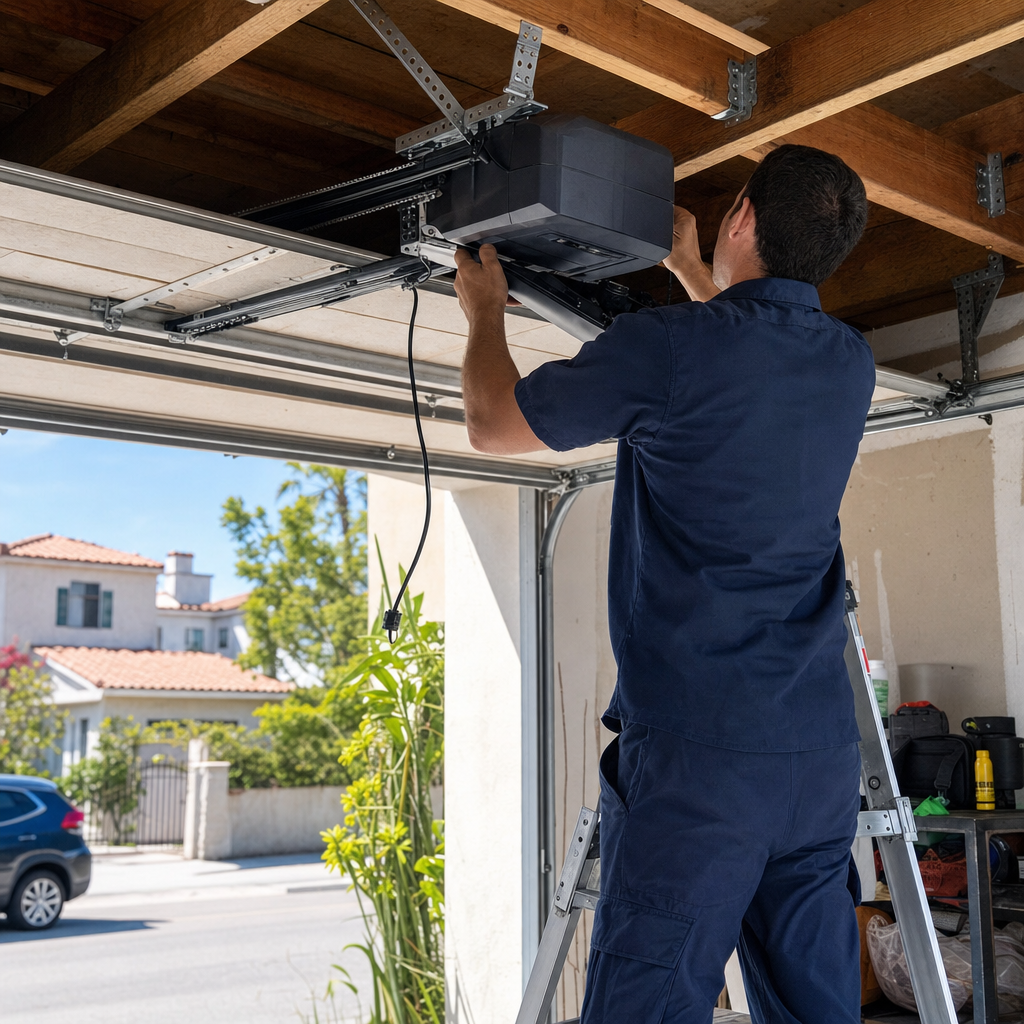
For the alley garages and ADU-adjacent spaces we mentioned earlier, a wall-mount or jackshaft opener — LiftMaster’s 8500W is the one we specify most often — eliminates the ceiling rail entirely, freeing up overhead space for storage and making it feasible to install a garage door in spaces where a traditional trolley opener simply won’t fit.
Wi-Fi-enabled openers have become essentially standard, and for good reason: the ability to check whether your garage door is open or closed remotely is genuinely useful, and automated close-on-timer features reduce the chance of leaving a door open overnight — a real security concern in any urban neighborhood. Genie’s Aladdin Connect platform and Chamberlain’s myQ both handle this well.
For a deeper look at opener selection, installation, and compatibility, our dedicated Garage Door Opener in Santa Monica page covers each model category in full detail.
A Maintenance Schedule Built for the Coast
Standard maintenance guidance — “lubricate once a year, call if something breaks” — isn’t enough in Santa Monica’s environment. Here is the maintenance schedule we recommend for coastal installations, based on nearly two decades of watching what actually fails and when.
- Every 3 months — Visual inspection of springs, cables, and rollers. Look for rust spots, fraying on cables, or any visible distortion in the spring coils. In coastal environments, corrosion can progress quickly between annual visits. Catching it early is far cheaper than an emergency replacement.
- Every 3 months — Lubricate hinges, rollers, and torsion spring. Use a silicone-based or lithium-based lubricant — never WD-40, which strips existing lubrication and attracts particulate. The salt-air environment means friction points accumulate corrosive deposits faster than in dry climates.
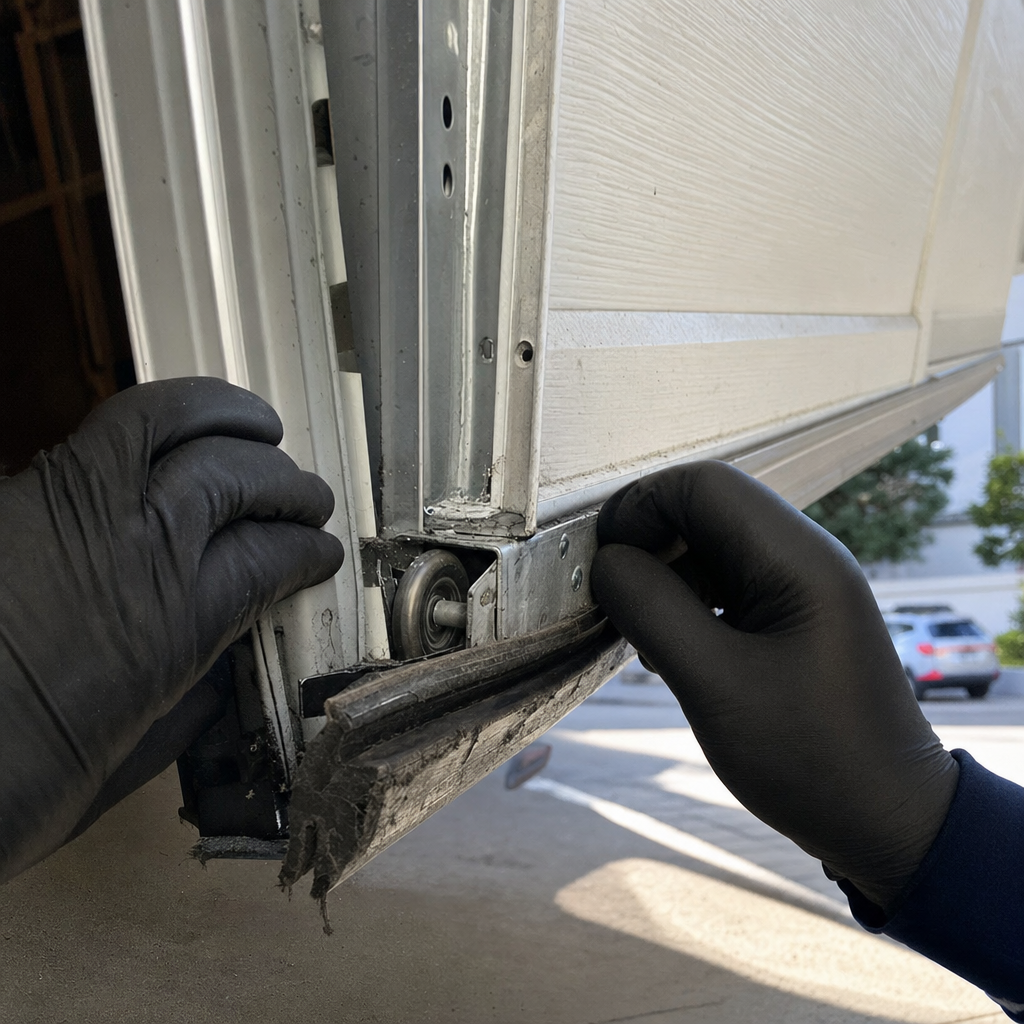
- Every 6 months — Check and replace weatherstripping. The bottom seal and side seals on a coastal-environment garage door dry out and crack faster due to UV and salt exposure. A compromised seal lets in salt-laden air and moisture, which accelerates interior hardware corrosion.
- Every 6 months — Test the auto-reverse safety feature. Place a flat 2×4 on the ground in the door’s path and close the door. It must reverse on contact. This is both a safety requirement and a diagnostic — a door that doesn’t reverse cleanly may have a spring or force-adjustment issue developing.
- Annually — Professional inspection of spring tension, cable condition, and track alignment. What you can check visually is limited. A technician can feel and measure tension, identify cable wear that isn’t yet visible, and catch track alignment drift before it turns into a panel-damaging bind.
- Every 2–3 years for steel or wood doors — Refinish or reseal exterior panel surfaces. Even quality factory finishes degrade under Santa Monica’s UV load and salt exposure. A refinishing or resealing before the surface breaks down preserves the substrate underneath and extends panel life significantly.
Common Mistakes to Avoid
- Buying a standard steel door for a beachfront or near-beach installation. The corrosion timeline in coastal Santa Monica is brutal for uncoated or standard-galvanized steel. Within five years, you’ll be managing rust on panels, springs, and tracks. Specify aluminum or fiberglass for oceanside homes — the premium pays for itself by year six.
- Skipping corrosion-resistant spring upgrades. Many contractors install standard springs because they’re cheaper to supply. In Santa Monica specifically, galvanized torsion springs with an additional coating — or stainless-steel springs for the most exposed installations — are worth the upcharge. We’ve replaced standard springs on three-year-old doors in the Ocean Park neighborhood. It’s avoidable.
- Choosing a chain-drive opener for an attached garage under a bedroom. Chain drives work, but in the quiet residential streets of North of Montana or the Sunset Park neighborhood, the mechanical noise at 6 a.m. gets old fast. Belt drives cost a little more; they cost less in goodwill with the rest of the household.
- Ignoring clearance requirements for ADU garage conversions. Santa Monica’s older garage stock often has non-standard header heights and side clearances. Ordering a standard track system without measuring for a low-headroom or vertical-lift configuration can result in a door that physically cannot open fully. Measure everything before ordering.
- Using WD-40 as a garage door lubricant. This is one of the most common DIY maintenance errors we see. WD-40 is a solvent and water displacer, not a lubricant. It removes existing lubrication and leaves metal surfaces more vulnerable to corrosion — the exact opposite of what you want in Santa Monica’s salt-air environment. Use white lithium grease or a silicone-based spray.
- Waiting for a complete failure before calling for service. Grinding noises, a door that moves unevenly, or a spring that’s visibly rust-streaked are not “watch and see” situations in a coastal environment. Those symptoms progress faster here than inland, and a $250 spring replacement becomes a $1,500 emergency call when the spring snaps on a Saturday morning.
- Assuming the lowest-bid installer has the same product knowledge as a specialist. Brand-specific hardware selection — the right spring rating for your door weight, the right track gauge for your headroom, the right opener for your clearance — requires hands-on experience with the products. General contractors and handymen who “also do garage doors” often get these specifications wrong, especially on non-standard Santa Monica garage configurations.
When to Call a Professional
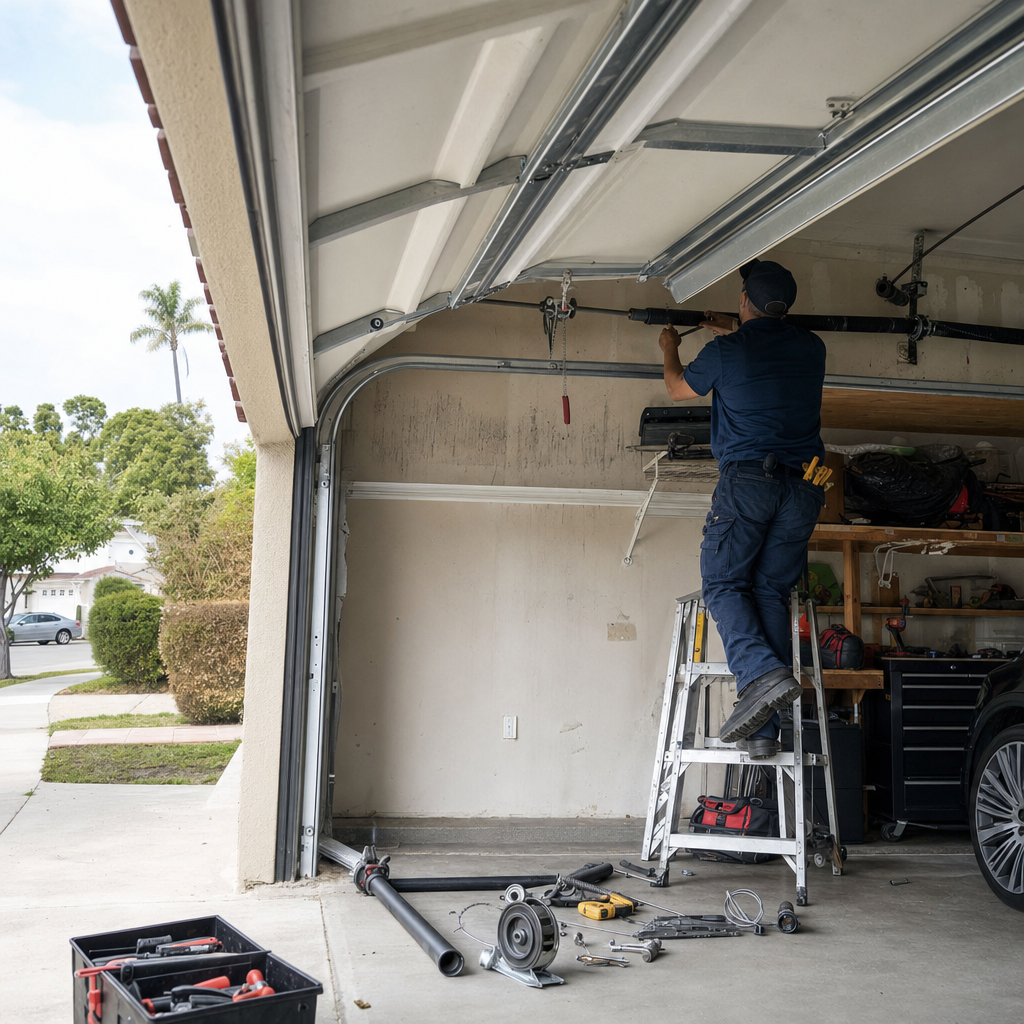
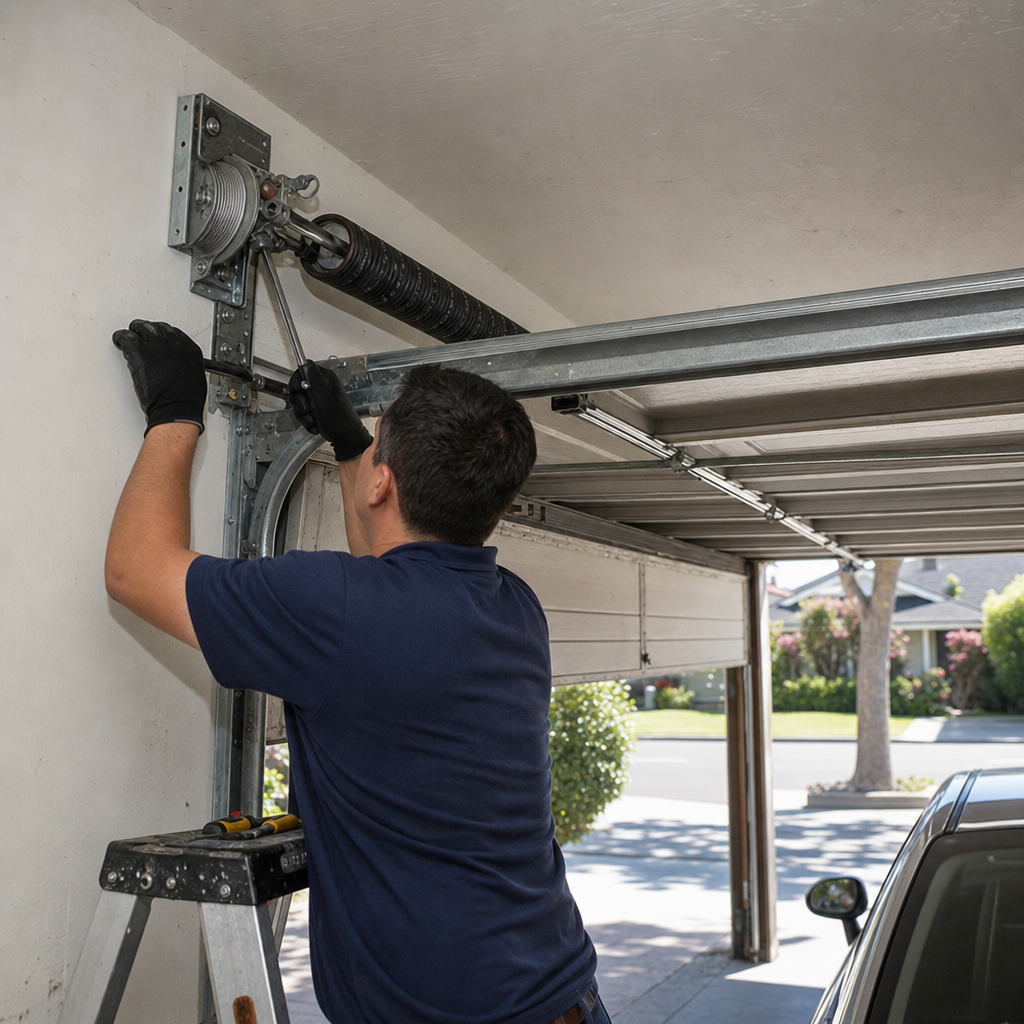
Call a professional immediately if your garage door won’t open or close at all — especially if a spring has visibly snapped (you’ll often hear the loud bang when it goes). Torsion spring replacement is not a DIY task; the springs are under extreme tension and the failure risk is serious. Similarly, if your door is moving but binding, jerking, or tilting to one side, stop using it. Operating a door with a damaged cable or misaligned track causes cascading damage to rollers, panels, and opener components that multiplies the repair cost.
For anything involving the spring system, cables, track realignment, or opener installation on an older or non-standard Santa Monica garage, professional service is the right call. If you notice early-stage rust on hardware or cables that aren’t yet failed, that’s the ideal moment to bring in a technician — catching it before it fails is far less expensive than emergency service.
Priority Garage Door Solutions Santa Monica offers free estimates throughout Santa Monica — call (844) 460-7214 and Matthew will assess the situation directly. For urgent situations, emergency garage door service is available when it can’t wait.
Frequently Asked Questions
How long should a garage door last in Santa Monica?
A properly maintained aluminum or fiberglass garage door in Santa Monica should last 20 to 30 years. Steel doors in coastal-adjacent locations typically last 10 to 15 years with good maintenance, and as few as 7 to 10 years within a few blocks of the ocean without corrosion-resistant hardware. The hardware — springs, cables, rollers — will need replacement before the door panels do, and that timeline compresses in proportion to your proximity to the water.
What’s the best garage door material for a home near the Santa Monica beach?
Aluminum is the best choice for homes nearest the water in Santa Monica — it’s rust-proof, and modern powder-coated aluminum doors hold up well under UV and salt-air exposure. Fiberglass is a close second and offers more aesthetic options for wood-look applications. Both outperform steel in coastal conditions over a ten-year-plus horizon. We recommend avoiding standard steel for any home within roughly half a mile of the shoreline.
How much does a new garage door installation cost in Santa Monica?
In Santa Monica’s current market, a complete garage door installation — new door, tracks, springs, and opener — typically ranges from $1,200 to $3,500 depending on door material, size, insulation level, and opener model. Single-car aluminum doors on the lower end; two-car insulated fiberglass or custom-panel doors with premium openers on the higher end. Getting a free estimate specific to your opening and configuration is the most accurate way to budget. For a full breakdown of installation factors, see our Garage Door Installation in Santa Monica page.
Do I need a permit to replace a garage door in Santa Monica?
In most cases, a like-for-like residential garage door replacement in Santa Monica does not require a building permit. However, if the work involves altering the opening size, structural modifications for an ADU conversion, or changes to fire-rated assemblies on an attached garage, a permit is typically required. Santa Monica’s Building and Safety Division can confirm your specific situation. When in doubt, ask — an unpermitted structural modification can create complications at resale.
Why does my garage door spring keep breaking in Santa Monica?
Frequent spring failures in Santa Monica are almost always a sign that standard springs are being installed in a coastal environment where salt-air corrosion demands a better spec. If your springs are failing within three to five years, the fix isn’t just replacing with the same spring — it’s upgrading to galvanized or powder-coated springs and increasing your lubrication frequency to every three months. In some beachfront locations, stainless-steel springs are worth the additional cost. We see this pattern consistently in homes along Ocean Avenue, Pacific Coast Highway-adjacent properties, and the streets of Sea Colony. For repair options, our Garage Door Repair in Santa Monica page covers spring service in detail.
How often should I have my garage door serviced in Santa Monica versus an inland area?
We recommend annual professional inspections for most homeowners, but in Santa Monica’s coastal environment — particularly for homes within a half mile of the ocean — a twice-yearly professional check of spring tension, cable condition, and hardware is more appropriate. The marine layer deposits salt on hardware year-round, not just during storm events, and the corrosion compounds between visits faster than it does in an inland climate. Catching degradation early, before a component fails, is consistently less expensive than emergency repair.
The Bottom Line
Your garage door in Santa Monica isn’t just a door — it’s a coastal-environment component that needs to be selected and maintained accordingly. The single most important decision you can make is choosing the right material for your proximity to the ocean: aluminum or fiberglass near the water, marine-grade steel further inland. After that, the next most valuable investment is a maintenance schedule that’s tighter than what the manual says — every three months for lubrication and inspection, not once a year. Do those two things right and your door will perform for twenty-plus years. Skip them and you’ll be replacing hardware and panels years before you should. Over 1,100 Santa Monica neighbors have trusted Matthew Anderson and Priority Garage Door Solutions with this work. We’d be glad to be your first and last call for any garage door need.
Ready to talk through your specific door, opening, or situation? Call us at (844) 460-7214 for a free estimate — Matthew handles the assessment personally, so you’ll get a straight answer from someone with nearly two decades of hands-on experience, not a call-center quote.
Written by the team at Priority Garage Door Solutions Santa Monica, serving Santa Monica since 2008.